
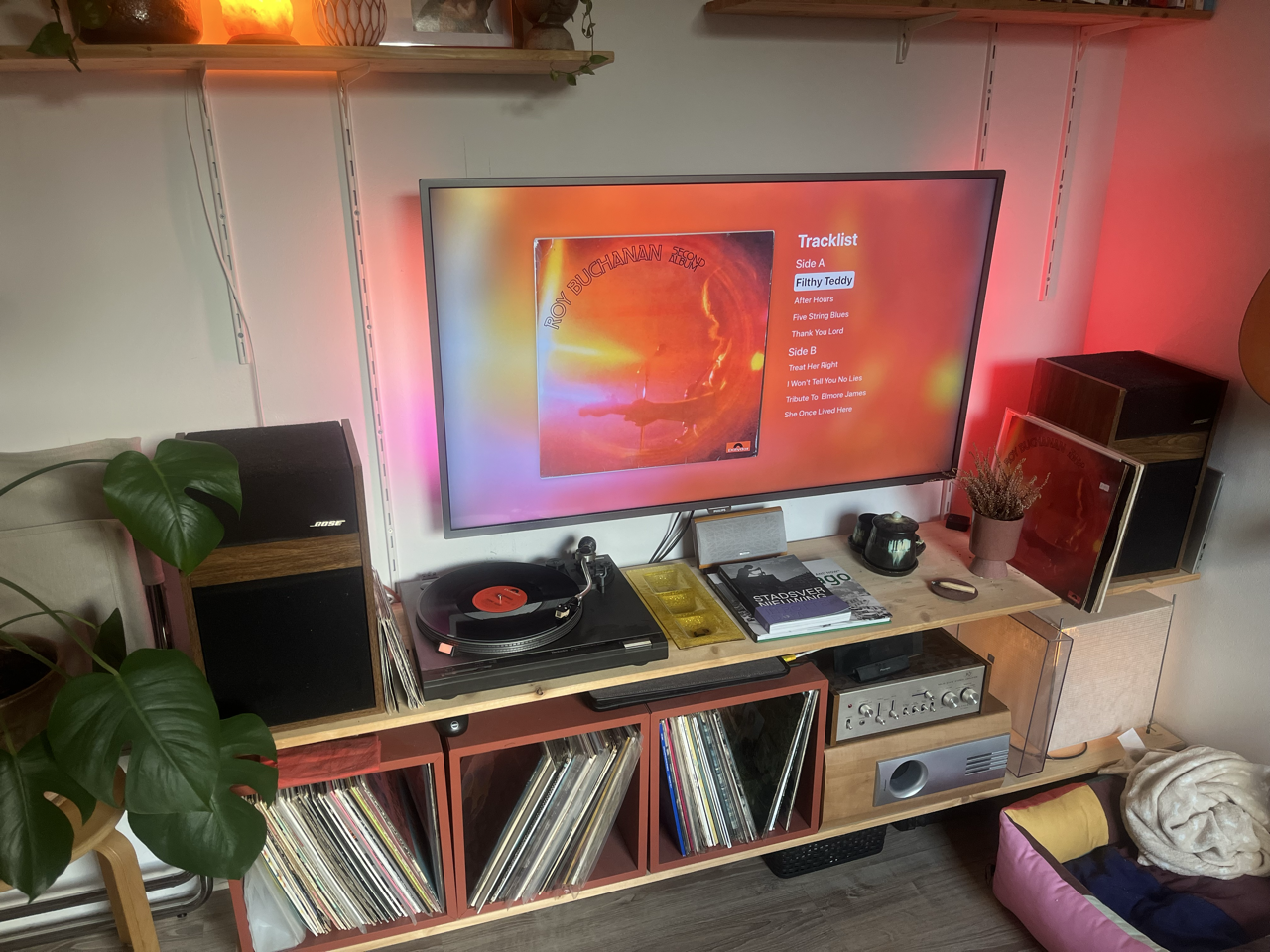
A few years ago I set up a small Icecast server to broadcast my record player around the apartment. With a cheap USB sound card and a Raspberry Pi I could cast the audio from my record player through AirPlay. At one point I started wondering if I could capture some of the analog charm and add it to my setup, so I started working on an interface that shows what’s spinning on the turntable.
From Streaming to Recognition
The basic setup stayed the same:
- Raspberry Pi with a Behringer USB sound card
- DarkIce + Icecast to stream vinyl audio at
http://localhost:8000/vinyl.mp3
The new layer was recognition. I integrated ACRCloud for audio fingerprinting and Discogs for metadata and album covers. ACRCloud is cheap and pretty accurate at identifying songs, but by itself it can’t know which physical record is spinning, only the specific track. That meant it would return any random release that happens to include the same song. That wasn’t the experience I wanted. When I put on a record, I want to see the record from my shelf represented, not just any release containing the track.
That’s when I figured Discogs already had my collection catalogued, so I linked recognition results against my own Discogs library through its API. This way, whenever ACRCloud recognizes a song, the app checks which matching release I actually own and displays that artwork, pressing, and tracklist.
Handling Silence, Live Albums, and Tracklists
Recognition gets messy if you don’t handle silence. Without filtering, the system would send snippets of quiet lead-in grooves or pauses between songs, producing random or bad results. I added a volume threshold: if the input falls below –50 dB, the system treats it as silence. Instead of showing outdated metadata, the UI displays a placeholder message telling you to put on a record.
Live albums created additional challenges. Applause, crowd noise, and stage banter were loud enough to trigger recognition, but not musical. To reduce false positives, I introduced a minimum duration filter: audio had to stay above threshold long enough before recognition ran.
I later refined the approach by waiting for a dip of several seconds to confirm a track had ended, then using the next volume increase as the trigger for the next song. This dip-plus-rise combination filtered out short pauses and or fades while catching the actual start of new tracks.
Ultimately I moved away from volume-based detection all together. ACRCloud provides an offset within the recognized snippet, so instead of repeatedly re-fingerprinting, I now fetch the entire tracklist once with the album metadata. My code uses the offset and track durations to calculate how much time is left in the current song, predict which track comes next, and advance automatically without additional recognition calls. This reduced API usage and produced a smoother, more reliable timeline.
And while I no longer rely on dips and rises for the interface, I didn’t throw that logic away. Instead, I tied it into Home Assistant. When a volume increase signals that a record has started, my receiver automatically switches from the Dolby 5.1 input to the analog channel so it instantly plays through the right system.
Displaying the Music
To make the experience feel native in the living room, I built a tvOS app in SwiftUI. The app reads the now_playing.json feed and displays album art alongside track details. I used a blurred, color-matched background behind the cover to keep the focus on the artwork without leaving empty space on the screen. The tracklist is aligned with the top of the album cover and given a fixed height so long lists scroll predictably, rather than floating off screen. These choices kept the interface minimal, responsive, and visually tied to the physical record that’s actually spinning.
Reflection
What began as a simple Icecast radio to stream vinyl across rooms has evolved into a full recognition and visualization system. I loved tweaking, (breaking) and refining my approach. Each hurdle turned into a small puzzle, and piecing those together to make the system more reliable was super satisfying.